Jev Choice vs Score vs Noul: Complete Guide
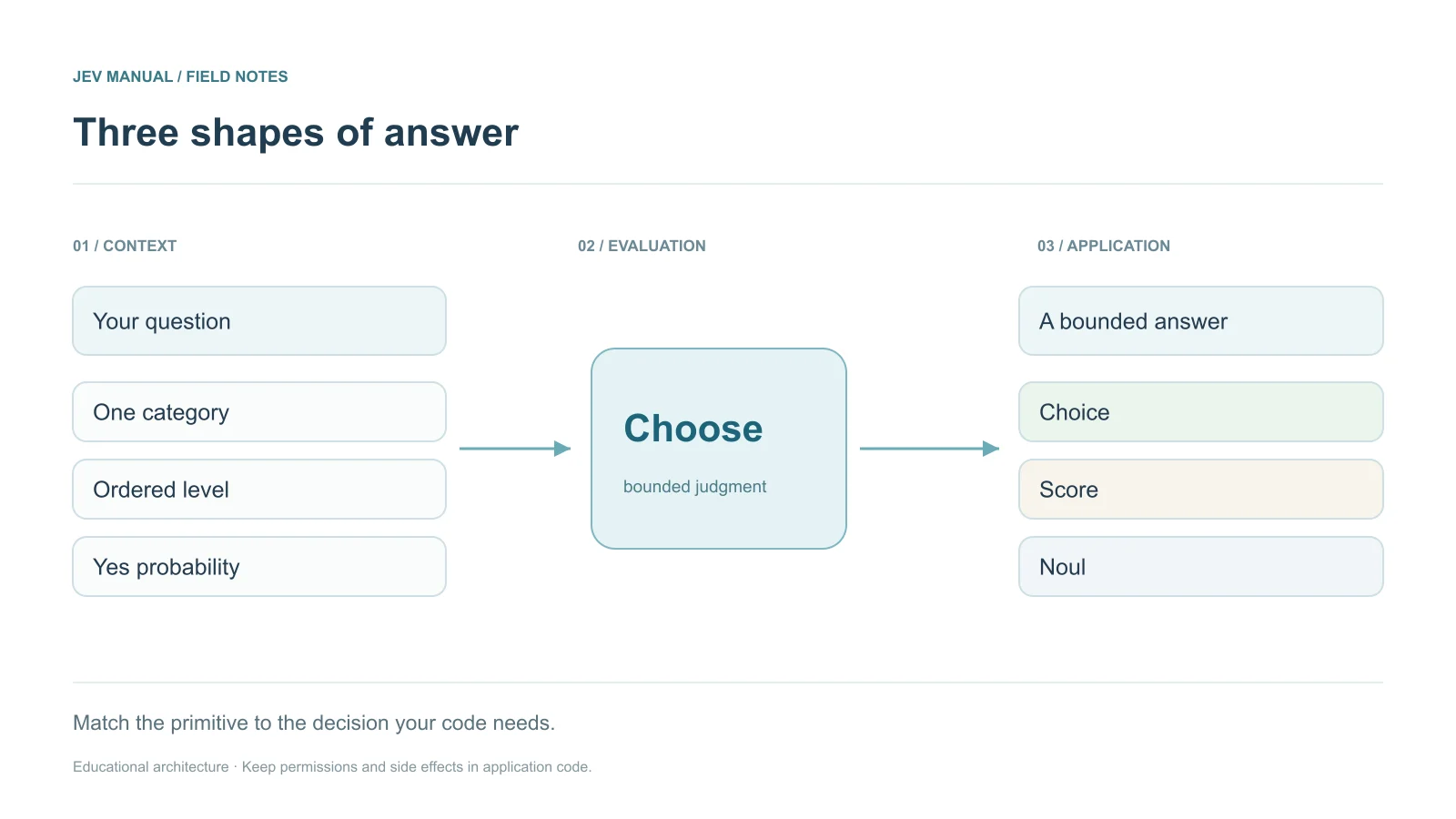
Choose a fixed category, an ordered rubric, or the probability of a single proposition.
On this page
Choose the answer space firstUse Choice when categories are unorderedUse Score when levels have an orderUse Noul for one propositionChoice vs NoulScore vs NoulOne question, one judgmentMix all three in one requestDecision flowchartChoose the answer space first
| Desired answer | Primitive | Support example |
|---|---|---|
| One category | Choice | Which team owns the ticket? |
| An ordered level | Score | How urgent is the request? |
| Yes probability | Noul | Is a refund explicitly requested? |
Use Choice when categories are unordered
Departments are not a scale: billing is not “more technical” than sales. Use a criteria map defining the categories and consider an other option when real input can fall outside them. Choice returns the winner, the distribution, and confidence.
Use Score when levels have an order
Urgency is an ordered judgment. Describe each level so the model can distinguish “this week” from “today” and “immediate harm.” Score uses an ordered array of between 2 and 10 descriptions. Its probability-weighted value can land between levels.
Use Noul for one proposition
“Does the customer explicitly request a refund?” is one yes/no question. Noul returns the probability of yes. A value near 0.5 represents uncertainty between yes and no, not a medium quantity of refunds.
Choice vs Noul
A two-category Choice can represent yes/no but has a different response shape. Prefer Noul when you directly need a probability that one proposition is true. Use Choice when named alternatives and a full category distribution make the application clearer.
Score vs Noul
“Is immediate action required?” asks about one proposition. “How urgent is the request?” asks for an ordered rubric. Replacing one with the other changes the meaning of the result; a Score of 0.8 is not automatically an 80% probability of anything.
One question, one judgment
Do not combine urgency, refund eligibility, and customer emotion in one label. They are independent dimensions. Ask all three separately and combine them in deterministic code. This makes errors attributable and weights explicit.
Mix all three in one request
Reuse one support-ticket state with a department Choice, urgency Score, and refund Noul. Read the API request for the complete JSON and multiple questions for dependency constraints.
Decision flowchart
If the task needs a fixed category, start with Choice. If it needs an ordered level, start with Score. If it asks whether one statement is true, start with Noul. Otherwise decompose the task or consider deterministic code or a generative model. Try the primitive selector.